
How We Calculate Home Addition Cost
This page explains how our home addition cost calculator builds a planning range from size, room type, finish level, structure, systems, permits, and state-level market differences.
The Core Formula
We do not return one fake exact number. We calculate a realistic planning range by combining build-rate logic with project-specific drivers.
Adjusted build rate
The per-square-foot rate changes based on addition type, finish level, project level, foundation type, roof complexity, access, and ceiling height.
Fixed project costs
Every addition carries some fixed planning and construction cost, even before room count, plumbing, or finish decisions expand the budget.
Risk buffer
Overhead, profit, and contingency are added at the end so the estimate behaves like a planning tool, not a misleading raw material quote.
Step-by-Step Estimate Logic
This is the calculation path we use to turn a project description into a useful home addition cost planning range.
Start with square footage
Square footage is the main base because structure, framing, enclosure, insulation, and finish labor all expand with project size.
Adjust for addition type
A bedroom, family room, bathroom, sunroom, garage, bump-out, and second-story addition do not carry the same base cost profile.
Layer in structural complexity
Story level, foundation choice, roof tie-in, ceiling height, and difficult access all change labor time, engineering need, and waste risk.
Add wet-room and system scope
Bathrooms, kitchens, wet bars, HVAC work, electrical upgrades, windows, and exterior doors can shift the estimate meaningfully.
Apply state market factor
Our current version uses state-level cost adjustments so the estimate is more useful than a flat national average.
Finish with permit, markup, and contingency
Final planning ranges include permit/design allowance, contractor overhead and profit, plus contingency for uncertainty.
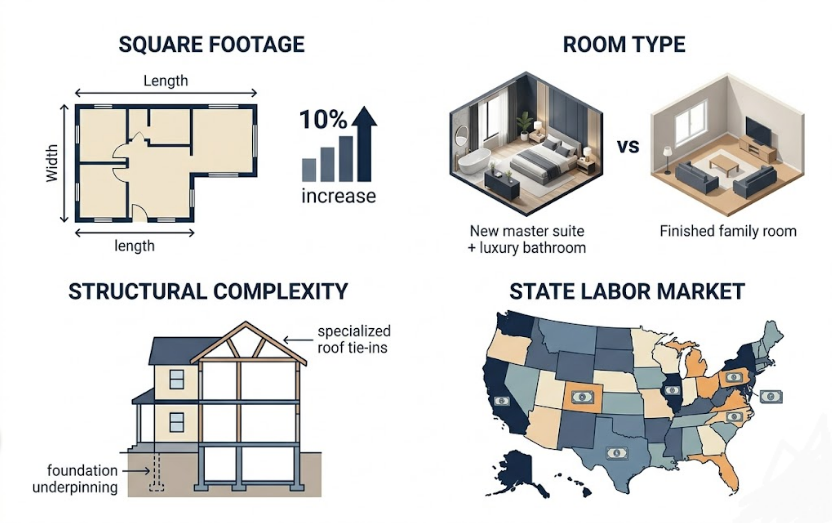
What Changes Home Addition Cost the Most?
Users searching how to calculate home addition cost usually want to know which inputs move the number most. These are the biggest drivers.
Square footage
More size means more framing, sheathing, roofing, drywall, flooring, paint, and trim. This is the biggest baseline driver.
Wet-room density
Bathrooms and kitchens raise plumbing, waterproofing, ventilation, fixture, and finish cost much faster than dry-room space.
Vertical and structural work
Second-story work, deep foundations, and complex roof tie-ins typically add engineering and labor pressure to the estimate.
State labor market
Location changes wage pressure, permit patterns, logistics, and contractor pricing. That is why state context is part of the model.
Important: Smaller additions can look expensive per square foot because fixed project costs are spread over less space. That is one reason reliable tools return ranges instead of one simplistic number.
What We Include vs What We Do Not Pretend to Finalize
This page is part of the trust layer. We show what the model is designed to estimate and where a contractor, designer, engineer, or permit office still matters.
| Included in the planning model | Not finalized by the planning model |
|---|---|
| Square footage and addition type logic | Final contractor bid and exact subcontractor scope |
| Finish-level impact on cost range | Exact material brand, product, and finish selections |
| Structural complexity adjustments | Site-specific engineering review |
| Bathrooms, wet areas, HVAC, electrical, windows, and doors | Hidden site conditions discovered after demolition |
| Permit/design allowance as a planning component | Final permit invoice and local approval path detail |
| State-level market factor | Exact neighborhood, lot, or contractor backlog pricing |
| Overhead, profit, and contingency | Guaranteed completion cost |
How State Location Changes the Estimate
State context is not a cosmetic filter. It changes labor assumptions, build-market pressure, and planning allowances.
Florida
Storm-resistant standards, moisture considerations, and local permit conditions can lift budgets above a simple national average.
Texas
Some markets are moderate overall, but major metro demand can push labor and schedule pressure beyond the baseline.
California
Higher labor rates, stricter code contexts, and permit complexity make many California additions more expensive than the national middle.
New York
Dense labor markets and approval complexity can widen both cost range and project timeline compared with lower-cost states.
Current model note: This version is state-driven. ZIP is present in the calculator for workflow and future refinement, but the current planning logic adjusts by state rather than precise ZIP-level contractor pricing.
Assumptions, Sources, and Update Policy
Authority and trust improve when the page explains how it is maintained. These are the source types and assumptions behind the model.
Source types
We rely on broad construction cost patterns, room-type cost behavior, permit/design allowances, system-upgrade logic, and regional market differences to create planning ranges.
Assumption style
The model assumes a normal residential addition workflow and then widens or narrows range behavior based on finish level, structure, access, and wet-area scope.
Refresh cadence
Visible dates should be updated whenever estimate logic, assumptions, state factors, or page content is materially refreshed.
Trust rule
We avoid fake guarantees, fake exact bids, fake review signals, and fake precision. This page exists to make the model easier to understand and trust.
Frequently Asked Questions
These FAQs support the methodology cluster around how to calculate home addition cost and explain how the estimate behaves.
How do you calculate home addition cost?
A reliable estimate starts with square footage, then adjusts for addition type, finish level, structure, systems, permits, and location. That is why a trustworthy calculator shows a range instead of one fake exact number.
Why does a bathroom addition usually cost more?
Bathrooms raise plumbing, waterproofing, ventilation, tile, fixture, and finish complexity. Even a modest bathroom scope can lift the total range faster than a similar dry-room footprint.
Does a second-story addition need a different cost method?
Yes. Second-story additions often need stronger structural assumptions, more engineering, roof work, and longer coordination time, so the estimate logic has to reflect that.
Why does the calculator use a state factor?
Labor markets, code conditions, logistics, and permit behavior vary by location. A state factor makes the tool more useful than a flat national average, even though it is still a planning model.
Are material prices the only thing that matter?
No. Materials matter, but labor, complexity, room type, systems, permit/design scope, and schedule risk can change the final estimate just as much or more.
Can a home addition calculator replace contractor quotes?
No. A calculator is best for early planning, comparing scenarios, and understanding cost drivers. Contractor bids, site review, engineering, and local code evaluation still determine final pricing.
Use the calculator with the methodology in mind.
The calculator and this methodology page work together: one gives the estimate, the other explains why the number moves. That combination is what makes the site more useful and more trustworthy.